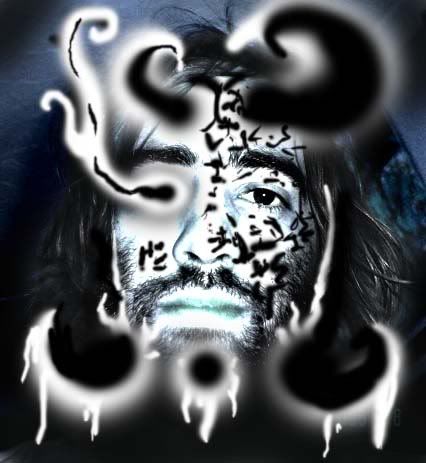
here is my final piece "FatBoy"
this upload is very dark and the quilty is bad so i will send in a high res dvd of all my animations.
Monday, January 15, 2007


Saturday, January 13, 2007
Bringing Aesop's Fables into the 21 century
A Review of Relevant Research
In this single project I plan to bring the moral concepts of Aesop’s fables into the 21st century but before I do this I must understand what a moral is and why it is so powerful.
When I started thinking about this assignment I planned to create little stories showing morals and animate them. Whilst Researching I found out that I wasn’t creating stories I was creating fables. So I decided to research into Aesop’s fables and tried to understand his work.Aesop's FablesThe Aesop's Fables refers to a collection of fables credited to Aesop (620—560 BC), a slave and story-teller that is believed to have lived in Ancient Greece. Aesop's Fables have become a blanket term for collections of brief fables, usually involving personified animals.
The fables remain a popular choice for moral education of children today. There are many stories included in Aesop's Fables, such as The Fox and the Grapes (from which the idiom "sour grapes" was derived), The Tortoise and the Hare, The North Wind and the Sun and The Boy Who Cried Wolf, are well-known throughout the world.
(Wikipedia: http://en.wikipedia.org/wiki/Aesop)
Aesop’s Fables contain a short narrative try to illustrate a hidden message.Each of his fables has a simple moral that hasn’t changed for hundreds of years. For example, the fable of The Tortoise and the Hare declares that: slow and steady wins the race.I asked myself what is the secret of his fables' appeal and how they are still around today. I started by reading some of his fables and noticed that they are all short, sometimes only a few lines and are never longer than a page. I think that this is why they are still remembered and thought of today.I also think that part of the appeal is that not only humans, but animals, rodents, fish and even the trees and plants talk within his fables.
In stories animals often make more sense than humans. When the animals do something controversial they seem to get away with it. I think that by using animals as characters, People can speak freely and frankly without offending anyone.FableIn its strict sense a fable is a short story or folk tale embodying a moral, which may be expressed explicitly at the end as a maxim.
"Fable" comes from Latin fabula (meaning 'conversation', 'narrative', 'tale') and shares a root with faber, "maker, artificer." Thus, though a fable may be conversational in tone, the understanding from the outset is that it is an invention, a fiction. A fable may be set in verse, though it is usually prose. In its pejorative sense, a fable is a deliberately invented or falsified account.(Oxford Dictionary)
Maxim Maxim. A fundamental principle or rule. A maxim is a wise saying, especially one intended to advise or recommend a course of conduct. In comparison to its approximate synonyms: saying, adage, saw, motto, epigram, proverb, aphorism, the term maxim stresses the succinct formulation of an ultimate truth, a fundamental principle, or a rule of conduct. The word derives from the Latin word maximus, "greatest", via an expression maxima propositio, "greatest premiss(Oxford Dictionary)
I really enjoyed reading and trying to understand Aesop’s fables, I would like to capture some of the magic of his work and translate it into the 21st century. I will try to make my animations more grey than black and white morals so that people can interpret them in different ways. I will start to create more story boards and more surreal morals.
I then realised that I still have not found out why these morals are so important to people and why they have stood the test of time. To find out this I had to research into more historical and philosophical areas and how morals have evolved.
I read the Philosophy book ‘The Evolution of Morality’ by Richard Joyce and it answered all of the questions I had about morality.
The main reasons why we have morals are that they are mutually beneficial for the survival and evolution of the Human race. Over the centuries the Human race needed to adapt to its surroundings therefore more morals came to exist.
If you compare the lifestyle of the 19th century to the 21st century the morals of day-to-day life would be considerably different. I personally think that the main reason for this would be the creation of mass communication devices such as the Telephone, the Television and the Internet. Today, most children spend more time on the communication devices than with their own family and friends. Family and friends have been the moral guidance for children throughout the existence of morals but now with these communication devices they have the most influence on all people today.
Joyce’s book explains how morals have evolved to what they are today, he explains in detail how innate emotions like motherly love and sacrificing ones self to help others are now embedded into our genes to allow the human race can evolve faster.
“It might be objected that a person enters into a reciprocal relationship for self-gain and thus is motivated entirely by selfish ends (albeit perhaps “enlightened self-interest”)-the very antithesis of moral thinking.” (Pg 142 The Moral Sense, The Evolution of Morality)
Here Joyce is describing ones self-gain as the basis of all moral thinking. I believe this to be true as he later describes in the book that some morals are community and socially helpful which means that in the end they do benefit each individual.
Joyce also talked about the morals that are imbedded within us.
“If the human moral sense is prepared for any particular subject matter, it is surely this. It therefore seems eminently reasonable to assume that reciprocal exchanges were a central evolutionary problem that morality was designed to solve.” (Pg 228 Living with an Adapted Mind, The Evolution of Morality)
I found that through evolution humans have developed an extensive range of inborn mental characteristics including memory, emotion, perception, deliberation, will and understanding. This implies that 10% of children’s character is innate. The child’s flexible mind is then drawn to learning morals rather than relying on natural mind set.
“John Locke, the father of the idea of the tabula rasa, credited humans with an extensive range of inborn mental faculties: memory, emotion, perception, deliberation, will and understanding etc.” (Pg 007 Human Nature, The Evolution of Morality.)
The first basic forms of morals are seen in primates when they are grooming each other. We can only speculate as to how and why this mutually beneficial grooming evolved. As we are animals ourselves we can learn by observing the behaviour of our evolutionary cousins the primate. Primates live in groups and learn from their peers. Each clan have different behavioural patterns and when it is time for the young to leave the group they take their learning experience with them through their genes the same could be said about morals within humans.
“In the words of Michael Ruse (1986:253), “Morality is a collective illusion foisted upon us by our genes.”” (Pg 002 The Nature of Morality, The Evolution of Morality)
The conclusion of this is, morals have been tried and tested over the years and the successful morals have been passed down through evolution to progress society and prosperity within the human race.
Through this research I discovered what a moral is, where they came from and why we need them. I also now also see that nearly every cartoon contains some sort of moral in some way but strangely enough we don’t see the darker more important morals that every child should know in current times e.g. Safety within a community, sexual consequences and the importance of family structure.
I looked for animations containing these morals and found an animated series on BBC Three called ‘Monkey Dust’
“Monkey Dust is an animated TV series that satirises the darker side of life in the United Kingdom. It deals with taboo subjects and has drawn controversy for its portrayal of murderers, paedophiles and single parents. It is often described as a "darker" version of Little Britain (a more mainstream British satire, ridiculing lesser controversies such as transvestitism and homosexuality). The first episode was aired on BBC Three on February 9, 2003 and there have been three series to date………… Each episode features animation by several different companies including Slinky Pictures, Nexus, Sherbet and Picasso Pictures, but is linked by recurring themes and jokes, and by seamless transitions between sketches. The episodes are untitled but instead are known by the characters introduced or the one-off sketches included. The principal writers and creators of the series were Harry Thompson and Shaun Pye, …………….The animation goes alongside contemporary music which helps the scenes to flow.” (http://en.wikipedia.org/wiki/Monkey_Dust)
Monkey Dust is a cutting-edge comedic animation created by a team of writers and is visualised by some of London's young animators. The series is set in a permanent urban nightmare that could be described as a nocturnal world inhabited by the sad, the lonely and the emotionally crippled.
From watching the animation in ‘Monkey Dust’ I found that the creators were very morally observant and not afraid to portray their controversial views. I will take this on board when developing my animations as it has taught me not to obscure my thoughts to please other people.
I also did some research on some other 20/21st century animators who have based their animations in some way on emotionally and morally surreal situations.
Richard Goleszowski.
Richard Goleszowski joined Bristol-based Aardman Animation in 1983, and began working on the likes of Morph and Peter Gabriel's ‘Sledgehammer’ video. He has also brought us the award-winning frolics of ‘Robbie the Reindeer in Hooves of Fire’. He's also directed Aardman's hugely-successful "Creature Comforts" series.
(http://en.wikipedia.org/wiki/Richard_Goleszowski)
Goleszowski uses animals to portray his stories in the same way that Aesop did in the past. I like the way the characters move on his animals in ‘Creature Comforts’ and ‘rex the runt’ which are both made using stop motion claymation.
After studying his works on facial movements in his animation I have been able to further my understanding about lip sinking and emotion. The thing about rex the run is that it’s surreal but believable and that’s what I am trying to achieve in my animations.
Don Hertzfeldt has also produced interesting animations that are surreal. I intend to use this surreal stylised environment to portray my moral story’s.
Don Hertzfeldt
‘Don Hertzfeldt (born August 1, 1976) is the creator of many short animated films. These films typically feature hand-drawn stick figures acting out combinations of slapstick and black humour along with heavier existential themes.
Hertzfeldt creates his films with traditional pen and paper animation, without the aid of computers. Instead he works mainly with 16mm or 35mm film cameras and occasionally employs relatively out-dated special effect techniques.’
‘In 2001 the animator's fifth major film "Rejected" was nominated for the Academy Award for Animated Short Film. In 2002 Hertzfeldt was named by Filmmaker Magazine as one of the "Top 25 Filmmakers to Watch".
Don Hertzfeldt is one of the funniest and sickest modern animators working today. I plan to combine his style with my style then create some cool animations.’
(http://en.wikipedia.org/wiki/Don_Hertzfeldt)
Don Hertzfeldt likes to use 16mm or 35mm film cameras as he can't see himself making a film in front of a computer. I am going to animate using flash as I have made some animations with it before and liked them.
Conclusion
By analysing the evolution of morality I believe Aesop’s fables are still relevant learning tools today and it is necessary to keep pursuing moral subjects within animations as people rely on television and the internet for guidance in life. Without these morals society would and will eventually break down. Animations like ‘Monkey Dust’ have attempted to bring current moral situations to life and I intend to do the same. This ends my exploration and research into bringing Aesop’s fables into the 21st Century.
Bibliography
Concise Oxford English Dictionary. Oxford University Press; 11Rev Ed edition 2006.
Joyce, R. The Evolution of Morality. The MIT Press 2006.
(http://en.wikipedia.org/wiki/Monkey_Dust)
(http://en.wikipedia.org/wiki/Richard_Goleszowski)
(http://en.wikipedia.org/wiki/Don_Hertzfeldt)
(http://en.wikipedia.org/wiki/Aesop)
Thursday, December 14, 2006
Test animation with colour
This took me around two full days to complete and is an excellent example of how the animation will look and feel. I am extremely pleased with this sketchy, dark look and I will be developing it throughout. The technical process was to export a sketched frame from Flash, print it out, draw with pen over it, scan it into Photoshop, add colour, import into Flash to create an AVI and then import into Adobe After Effects to adjust the colour and contrast.
I will now begin the long task of completing the colouring throughout the animation. I will also be writing my essay on my research into the evolution of morality.
Thursday, December 07, 2006
'Fatboy' with sound
I worked closely with my sound technician to create the ambiance and sound effects I was looking for. Now that this is done it brings me one step closer to realising the full potential of this animation.
Wednesday, December 06, 2006
Test colour still
 This is the look I will be aspiring to for the final animation 'Fatboy'. I have not experienced colouring in 2D animation but creating this one picture took a long time and I hope that I can complete the animation to this standard in time for the deadline.
Wednesday, November 29, 2006
Test Fatboy animation (no sound)
Below is my test animation 'Fatboy'.
This still looks very incomplete as there is no colour or sound to give it life. Some people doubted that this animation would work as it didn't follow the story completely is very surreal. I was given an option to either bring it back to reality or to delve further into more of a surreal view. I thought about this for a week or so and came to the conclusion that experimentation with surrealism would me more effective and productive for the direction I wish to take.
I now wish to add surreal sounds and dark and dingy colours to make this animation stand out from the crowd.
This still looks very incomplete as there is no colour or sound to give it life. Some people doubted that this animation would work as it didn't follow the story completely is very surreal. I was given an option to either bring it back to reality or to delve further into more of a surreal view. I thought about this for a week or so and came to the conclusion that experimentation with surrealism would me more effective and productive for the direction I wish to take.
I now wish to add surreal sounds and dark and dingy colours to make this animation stand out from the crowd.
Fatboy storyboard

After completing my five animations I discussed the outcome with my tutors. We agreed that a final coloured animation would be appropriate to complete this single project.
I decided that I would like to create an adaptation of an existing fable. I chose to adapt the story of 'The Dog and the Wolf'
Based on the Aesop's fable 'the dog and the wolf' this animation is about a fat kid's struggle with fast food and how he feels trapped by it.
In the Aesop's fable 'dog and the wolf'.
A dog meets a wolf in a forest
Dog "you look hungry come back to my house and have some food".
Wolf "ok thanks"
Dog "oh yes you must also wear this collar 6 hours a day"
Wolf "no way! Forget it! Ill rather starve!
The wolf runs off into the forest
The moral: I would rather be starving and free than full and entrapped.
I decided to take the extremes of the concept 'starving' and 'full' and make characters of them. I also wanted an evil character to be the owner of the full character. Here are some sketches
In the Aesop's fable 'dog and the wolf'.
A dog meets a wolf in a forest
Dog "you look hungry come back to my house and have some food".
Wolf "ok thanks"
Dog "oh yes you must also wear this collar 6 hours a day"
Wolf "no way! Forget it! Ill rather starve!
The wolf runs off into the forest
The moral: I would rather be starving and free than full and entrapped.
I decided to take the extremes of the concept 'starving' and 'full' and make characters of them. I also wanted an evil character to be the owner of the full character. Here are some sketches

Sunday, November 19, 2006
Animations with sound
Adam Newland assisted me with the creation of sound for these animations. I think they work and have a much better feel to them now. although the animation 'religion' could be found offensive to some people. I hope people can see through this as only the ignorant get offended.
sexual health
I think that by adding sound to this animation it has greatly improved. By adding a humorous impact that was drastically needed.
Biker
Adding sound has made this animation more succsessful than before as it shows what the biker is feeling.
religion
I really like the sounds have we have created but now it could be possible people could mistake this as an attack on their faith. This is not what I am portraying and anyone who feels insulted must take a look at the world today.
tree baby
I think that this is the most successful animation as it has turned out exactly as I wanted it to.
soldiers
I was extremely pleased with the changes I have made as it brings an element of self-learning and interaction with the viewer.
sexual health
I think that by adding sound to this animation it has greatly improved. By adding a humorous impact that was drastically needed.
Biker
Adding sound has made this animation more succsessful than before as it shows what the biker is feeling.
religion
I really like the sounds have we have created but now it could be possible people could mistake this as an attack on their faith. This is not what I am portraying and anyone who feels insulted must take a look at the world today.
tree baby
I think that this is the most successful animation as it has turned out exactly as I wanted it to.
soldiers
I was extremely pleased with the changes I have made as it brings an element of self-learning and interaction with the viewer.
Friday, November 03, 2006
Animation's (no sound)
Here are my test animations (Work in progress!) I will not say what they are truly about as the viewer’s can interpret them as they want. All the animations have no sound at the moment as I am going to be working with a sound technition student to create them. Hopefully they will all be finished within 2 weeks.
Biker
I wanted to portray the emotion of road rage within this animation.
religion
This animation illustrates the fact that some religions are forced on people.
baby tree
This animation illustrates the deforestation and the emotions behind it.
sexual health
With this animation I am trying to illustrate the illusions of safe sex.
soldiers
I changed the story of this animation as I thought that this moral would be more appropriate for the current time.
Biker
I wanted to portray the emotion of road rage within this animation.
religion
This animation illustrates the fact that some religions are forced on people.
baby tree
This animation illustrates the deforestation and the emotions behind it.
sexual health
With this animation I am trying to illustrate the illusions of safe sex.
soldiers
I changed the story of this animation as I thought that this moral would be more appropriate for the current time.
Thursday, October 19, 2006
Research: Aesops Fables
In my assignment I planned to create little stories showing morals and animate them.
Whilst Researching I found out that I wasn’t creating stories I was creating fables. So I decided to research into Aesop’s fables and tried to understand his work.
Aesop's Fables
"The Aesop's Fables refers to a collection of fables credited to Aesop (620—560 BC), a slave and story-teller that lived in Ancient Greece. Aesop's Fables have become a blanket term for collections of brief fables, usually involving personified animals. The fables remain a popular choice for moral education of children today. There are many stories included in Aesop's Fables, such as 'The Fox and the Grapes '(from which the idiom "sour grapes" was derived), 'The Tortoise and the Hare', 'The North Wind and the Sun' and 'The Boy Who Cried Wolf', are well-known throughout the world. In the 3rd century AD Apollonius of Tyana,"
(Wikipedia: http://en.wikipedia.org/wiki/Aesop)
Aesop’s Fables contain a short narrative try to illustrate a hidden message.
Each of his fables has a simple moral that hasn’t changed for hundreds of years. For example, the fable of 'The Tortoise and the Hare' declares that: slow and steady wins the race.
I asked myself what is the secret of his fables' appeal and how they are still around today. I started by reading some of his fables and noticed that they are all short, sometimes only a few lines and are never longer than a page. I think that this is why they are still remembered and thought of today.
I also think that part of the appeal is that not only humans, but animals, rodents, fish and even the trees and plants talk within his fables. In stories animals often make more sense than humans. When the animals do something controversial they seem to get away with it. I think that by using animals as characters, Aesop could speak freely and frankly without offending anyone.
Fable
"In its strict sense a fable is a short story or folk tale embodying a moral, which may be expressed explicitly at the end as a maxim. "Fable" comes from Latin fabula (meaning 'conversation', 'narrative', 'tale') and shares a root with faber, "maker, artificer." Thus, though a fable may be conversational in tone, the understanding from the outset is that it is an invention, a fiction. A fable may be set in verse, though it is usually prose. In its pejorative sense, a fable is a deliberately invented or falsified account."
(Oxford Dictionary)
Maxim
"Maxim. A fundamental priniciple or rule. A maxim is a wise saying, especially one intended to advise or recommend a course of conduct. In comparison to its approximate synonyms: saying, adage, saw, motto, epigram, proverb, aphorism, the term maxim stresses the succinct formulation of an ultimate truth, a fundamental principle, or a rule of conduct. The word derives from the Latin word maximus, "greatest", via an expression maxima propositio, "greatest premiss"
(Oxford Dictionary)
I really enjoyed reading and trying to understand Aesop’s fables, I would like to capture some of the magic of his work and translate it into the 21st century. I will try to make my animations more grey than black and white morals so that people can interprate them in different ways. I will start to create more storyboards and more surreal morals.
Whilst Researching I found out that I wasn’t creating stories I was creating fables. So I decided to research into Aesop’s fables and tried to understand his work.
Aesop's Fables
"The Aesop's Fables refers to a collection of fables credited to Aesop (620—560 BC), a slave and story-teller that lived in Ancient Greece. Aesop's Fables have become a blanket term for collections of brief fables, usually involving personified animals. The fables remain a popular choice for moral education of children today. There are many stories included in Aesop's Fables, such as 'The Fox and the Grapes '(from which the idiom "sour grapes" was derived), 'The Tortoise and the Hare', 'The North Wind and the Sun' and 'The Boy Who Cried Wolf', are well-known throughout the world. In the 3rd century AD Apollonius of Tyana,"
(Wikipedia: http://en.wikipedia.org/wiki/Aesop)
Aesop’s Fables contain a short narrative try to illustrate a hidden message.
Each of his fables has a simple moral that hasn’t changed for hundreds of years. For example, the fable of 'The Tortoise and the Hare' declares that: slow and steady wins the race.
I asked myself what is the secret of his fables' appeal and how they are still around today. I started by reading some of his fables and noticed that they are all short, sometimes only a few lines and are never longer than a page. I think that this is why they are still remembered and thought of today.
I also think that part of the appeal is that not only humans, but animals, rodents, fish and even the trees and plants talk within his fables. In stories animals often make more sense than humans. When the animals do something controversial they seem to get away with it. I think that by using animals as characters, Aesop could speak freely and frankly without offending anyone.
Fable
"In its strict sense a fable is a short story or folk tale embodying a moral, which may be expressed explicitly at the end as a maxim. "Fable" comes from Latin fabula (meaning 'conversation', 'narrative', 'tale') and shares a root with faber, "maker, artificer." Thus, though a fable may be conversational in tone, the understanding from the outset is that it is an invention, a fiction. A fable may be set in verse, though it is usually prose. In its pejorative sense, a fable is a deliberately invented or falsified account."
(Oxford Dictionary)
Maxim
"Maxim. A fundamental priniciple or rule. A maxim is a wise saying, especially one intended to advise or recommend a course of conduct. In comparison to its approximate synonyms: saying, adage, saw, motto, epigram, proverb, aphorism, the term maxim stresses the succinct formulation of an ultimate truth, a fundamental principle, or a rule of conduct. The word derives from the Latin word maximus, "greatest", via an expression maxima propositio, "greatest premiss"
(Oxford Dictionary)
I really enjoyed reading and trying to understand Aesop’s fables, I would like to capture some of the magic of his work and translate it into the 21st century. I will try to make my animations more grey than black and white morals so that people can interprate them in different ways. I will start to create more storyboards and more surreal morals.
Sunday, October 15, 2006
BBC Newtalent animation competition
I will be sending my animations to this competition when I have finished.
http://www.bbc.co.uk/newtalent/comedy/animation/
The closing date for entries is midnight on Sunday 31st December 2006.
"During January 2007, our top 60 sketches will be showcased on the BBC New Talent website. The public will have a chance to vote for their favourites over this time, and these votes will be taken into consideration by our panel of judges."
(BBC Talent)
http://www.bbc.co.uk/newtalent/comedy/animation/
The closing date for entries is midnight on Sunday 31st December 2006.
"During January 2007, our top 60 sketches will be showcased on the BBC New Talent website. The public will have a chance to vote for their favourites over this time, and these votes will be taken into consideration by our panel of judges."
(BBC Talent)
Thursday, October 12, 2006
Wednesday, October 11, 2006
Baby tree face test
 Here are some character tests of the surreal character 'babyseed'. I created these tests to experiment with different facial features and expressions. I am happy with this character and am now starting to animate with it.
Animators Survival Kit page 40-66

I found my book mark at page 40! I started reading it last year but had to work on the Gameplay project so I had to stop reading. Today I read from page 40 to page 66. which is about 25 pages all together. I learnt alot about Extremes, Inbetween's, Breakdowns, Ease Out/In's, and Key's.
I also learnt that I am a "Straight Ahead" animator! which has lots of disadvantages :(
I will try to use the "Pose to Pose" animating process now with one of my animations.
I also learnt that I am a "Straight Ahead" animator! which has lots of disadvantages :(
I will try to use the "Pose to Pose" animating process now with one of my animations.
Research: Richard Williams

Throughout this project I will be constantly referring to Richard Williams book 'The Animators Survival Kit' as it has all the animation know how I need for this project.
I want to have read the whole of this book by the end of this semester. This will truly help my understanding of weight in 2D and 3D animation.
Richard Williams 'The Animators Survival Kit' 2001 p001-342
12 weeks left
84 days left
342 pages in 'The Animators Survival Kit'
If my calculations are right I will need to read 4 pages a day minimum. Witch is OK I guess.
I think it will drastically improve my animation knowledge.
Research: Richard Golesowski

Richard Goleszowski.
Richard Goleszowski joined Bristol-based Aardman Animation in 1983, and began working on the likes of Morph and Peter Gabriel's 'Sledgehammer' video. He has also brought us the award-winning frolics of 'Robbie the Reindeer in Hooves of Fire'. He's also directed Aardman's hugely-successful 'Creature Comforts' series.
I have chosen Richard Goleszowski to research, as I like the way the lips move on his characters and animals. 'Creature Comforts' and 'rex the runt' are both made in stop motion claymation.
I am going to study his works on facial movements in his animation to further my understanding about lipsinking and emotion.The thing about rex the run is that it’s surreal but believable and that’s what I am trying to achieve for my animations.
here is some of his work's
'rex the runt'
http://www.youtube.com/watch?v=PTOivRZqMxw&mode=related&search=
Research: Don Hertzfeldt

Don Hertzfeldt (born August 1, 1976) is the creator of many short animated films. These films typically feature hand-drawn stick figures acting out combinations of slapstick and black humor along with heavier existential themes.
Hertzfeldt creates his films with traditional pen and paper animation, without the aid of computers. Instead he works mainly with 16mm or 35mm film cameras and occasionally employs relatively out-dated special effect techniques.
In 2001 the animator's fifth major film 'Rejected' was nominated for the Academy Award for Animated Short Film. In 2002 Hertzfeldt was named by Filmmaker Magazine as one of the "Top 25 Filmmakers to Watch."
Don Hertzfeldt is one of the funniest and sickest modern animators working today. I plan to combine his style with my style then create some cool animations.
Don Hertzfeldt likes to use 16mm or 35mm film cameras as he can't see himself making a film in front of a computer. I am going to animate using flash as I have made some animations with it before and liked them.
He said “it’s just another tool, and the problem is that people don't understand that the format you shoot on is just as important as picking whether to shoot in colour or black and white. It changes your entire film”
I will take this into consideration when animating although I think this type of animation will suite flash perfectly.
To see some of his work follow the link below.
'rejected'
Tuesday, October 10, 2006
Animation 2 Flower love

Story: Flower love
Simple nice Bob goes to smell the flowers but one gets stuck up his nose!
All the small flowers laugh as Bob goes crazy! Bob is about to stamp on the little flowers but when he looks up he see's that a massive sunflower is watching him and judging him! The sunflower kills Bob as the little flowers dance in his blood.
I got the concept for this from our criminal justice system. Would people be happier in the UK if the death sentence was brought back?

Animation 1 Baby Tree
 Story 1 (baby tree)
Cute little seed baby tries it hardest to grow into a big strong tree, then Mr Chainsaw guy appears and kills him for the lumber!
I want to portray the emotions of a tree as if it was alive. You could say that trees are alive already and we are just murdering them. The true quote at the end forces you to think about the mass murders that some companies are committing for financial gain.

Monday, October 09, 2006
Test animations
baby tree test
http://www.youtube.com/watch?v=5lgz6twykNg
flower love test
http://www.youtube.com/watch?v=YPuV11pbHRI
I have a story for both of them and am creating the storyboards now!
http://www.youtube.com/watch?v=5lgz6twykNg
flower love test
http://www.youtube.com/watch?v=YPuV11pbHRI
I have a story for both of them and am creating the storyboards now!
Test sketches
 Here are some test character sketches I have been working on.
Whist doing these sketches I was thinking of small moral situations that these creatures could help me to portray in a humorous fashion. I will try to experiment further in this style to create some other surreal characters.
Introduction
Aim:
To produce several abstract characters that will interact with each other within 5 short humorous 2D flash animations.
Process:
I will start by sketching lots of abstract characters in black and white, once I have done this I will chose the best characters and start to develop them in a storyboard. I will then experiment with their movements, personalities, morals and emotions. I will put them into short funny situations also experimenting with voice over’s, lip sinking and style.
Research:
I will research into several animators including don hertzfeldt (rejected) Richard Golezsowski (creator of Rex the Runt) John Kricfalusi (Creator of Ren And Stimpy).
Outcome:
5 short 2D animation’s of funny abstract humour.
To produce several abstract characters that will interact with each other within 5 short humorous 2D flash animations.
Process:
I will start by sketching lots of abstract characters in black and white, once I have done this I will chose the best characters and start to develop them in a storyboard. I will then experiment with their movements, personalities, morals and emotions. I will put them into short funny situations also experimenting with voice over’s, lip sinking and style.
Research:
I will research into several animators including don hertzfeldt (rejected) Richard Golezsowski (creator of Rex the Runt) John Kricfalusi (Creator of Ren And Stimpy).
Outcome:
5 short 2D animation’s of funny abstract humour.
Subscribe to:
Comments (Atom)